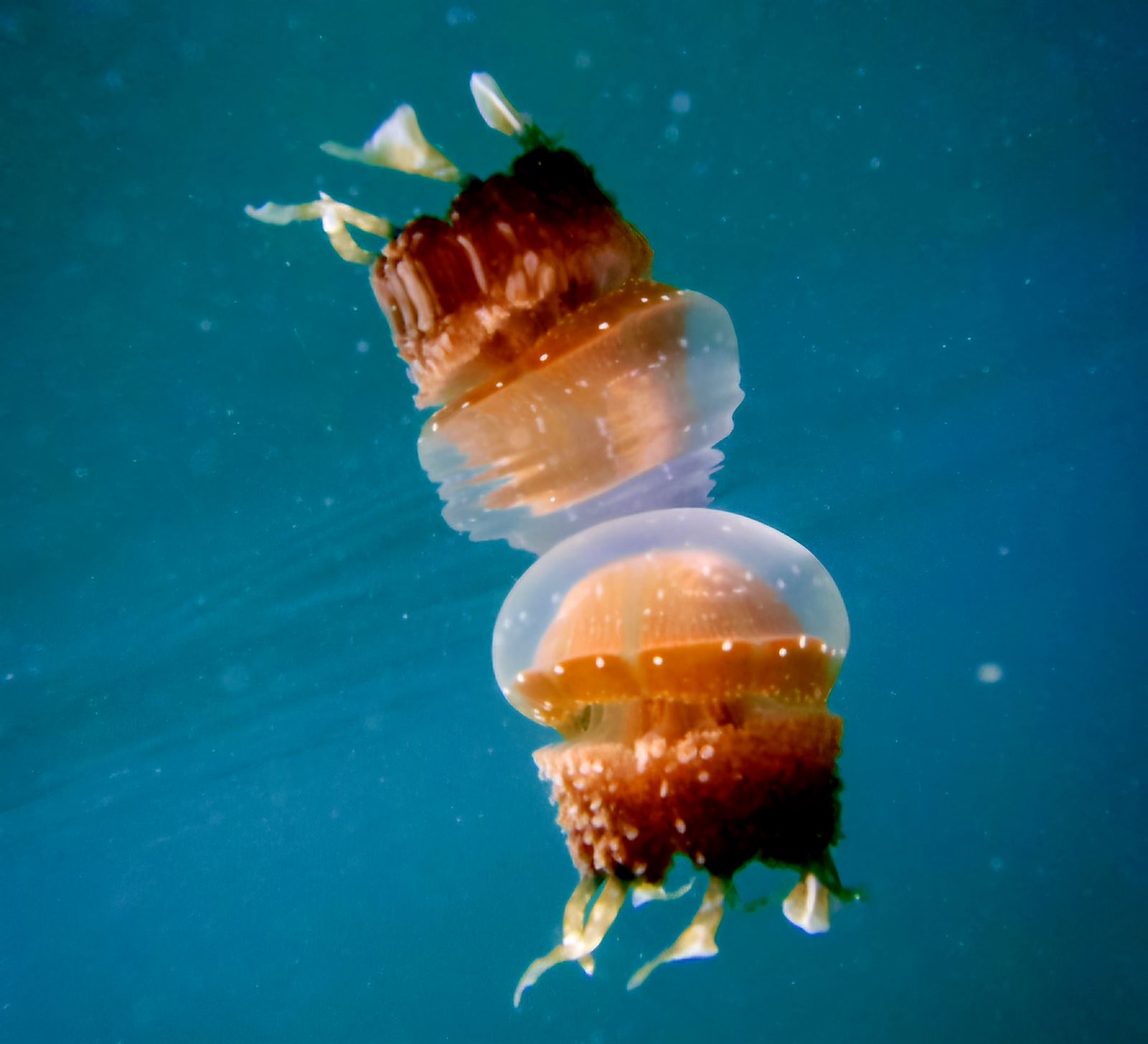
Stingless Jellyfish
In sheltered marine lakes, Mastigias-type jellyfish can be abundant and largely harmless to swimmers.
- Local name: Ubur-ubur tak menyengat
- Scientific name: Mastigias-type
Lake Mariona hosts dense populations of stingless jellyfish that pulse slowly through sunlit water. These Mastigias-type jellyfish have lost most of their sting through isolation in the lake, making it possible to swim among thousands of them safely.
Key facts
- Habitat
- Isolated marine lakes and enclosed lagoons
- Diet
- Plankton plus symbiotic algae
- Size
- Usually 8-10 cm bell diameter
- Behavior
- Slow drifters; gather in sunlit water; daily movements
Where to see it
Lake Mariona, an enclosed marine lake on Kadidiri, is the only reliable place to see them in the Togeans. Populations fluctuate with seasons and conditions, but on good days the lake holds thousands, concentrated in the sunlit upper layers.
How to spot it
Enter the lake slowly and wait for your eyes to adjust — amber-colored bells will appear pulsing gently in the water column. They concentrate in sunny patches, following the light throughout the day. Move carefully to avoid collisions.
Watching responsibly
- Don't touch or scoop them — even gentle handling damages their delicate tissue.
- Swim without fins to reduce injury risk — float and move slowly through the lake.
- Skip sunscreen and lotions before entering — oils harm the enclosed ecosystem.
- No soap, shampoo, or other products on your skin — the lake is chemically sensitive.
Conservation
Highly sensitive to pollution and temperature shifts in enclosed lake ecosystems.
Ready to see it for yourself?
Our cruises run from Luwuk through the Togean archipelago. Check the departure schedule, or message us and we'll help you pick the trip that fits.